
For the last few years, the conversation around stablecoins has largely centered on potential.
Could they make payments faster? Could they simplify cross-border money movement? Could they create new opportunities for businesses and consumers?
Increasingly, these questions have been answered.
Stablecoins are already supporting treasury operations, settlement, cross-border transfers and payouts around the world. Their growing role in real-world payment and money movement use cases reflects a broader evolution in how value moves through the digital economy. In this article, we have explored what that shift looks like in practice and Visa's role in supporting the ecosystem.
The more interesting question that has kept me up at night recently is different: What needs to happen for stablecoins to operate on an institutional scale?
While the industry has made significant progress proving the utility of stablecoins, moving from adoption to implementation is an entirely different challenge.
The bottleneck isn't demand
Across Asia Pacific, interest in stablecoins continues to grow.
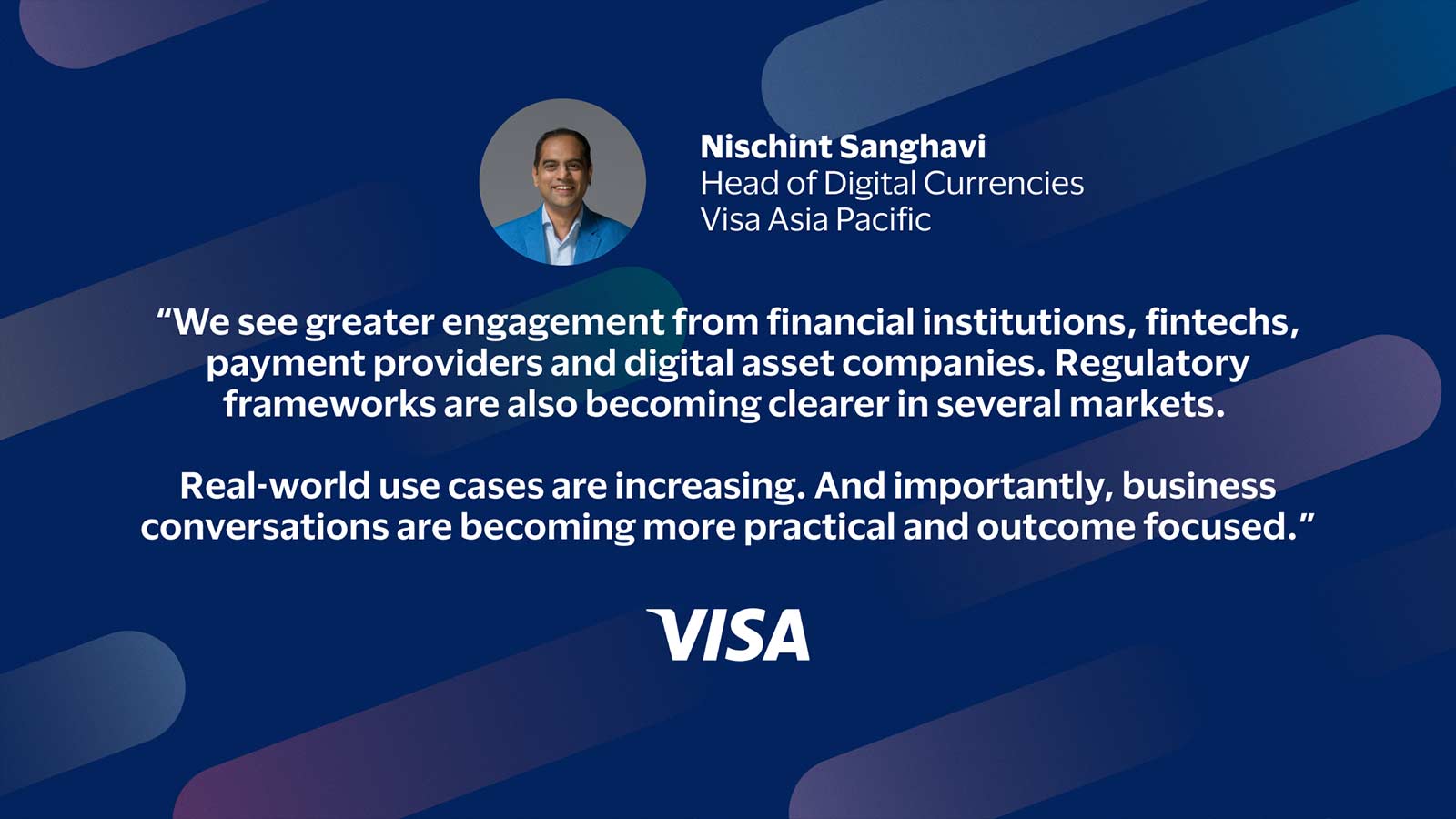
We see greater engagement from financial institutions, fintechs, payment providers and digital asset companies. Regulatory frameworks are also becoming clearer in several markets. Real-world use cases are increasing. And importantly, business conversations are becoming more practical and outcome focused.
But when institutions explore stablecoins, they often encounter the same challenge.
The obstacle is rarely understanding the technology itself. Instead, the challenge is operational.
Why infrastructure matters more than ever
This is why I believe the next chapter of stablecoin adoption will be defined by infrastructure.
For stablecoins to become a meaningful part of the financial system, institutions need more than access to digital assets. They need trusted operating environments, governance frameworks, security controls and connectivity into the payment ecosystems they already rely on.
In many ways, this mirrors the evolution of payments more broadly.
Success is rarely driven by a single product or technology. It comes from creating the infrastructure that allows innovation to operate safely, reliably and at scale.
For stablecoins, we are now entering that phase.
Moving from exploration to implementation
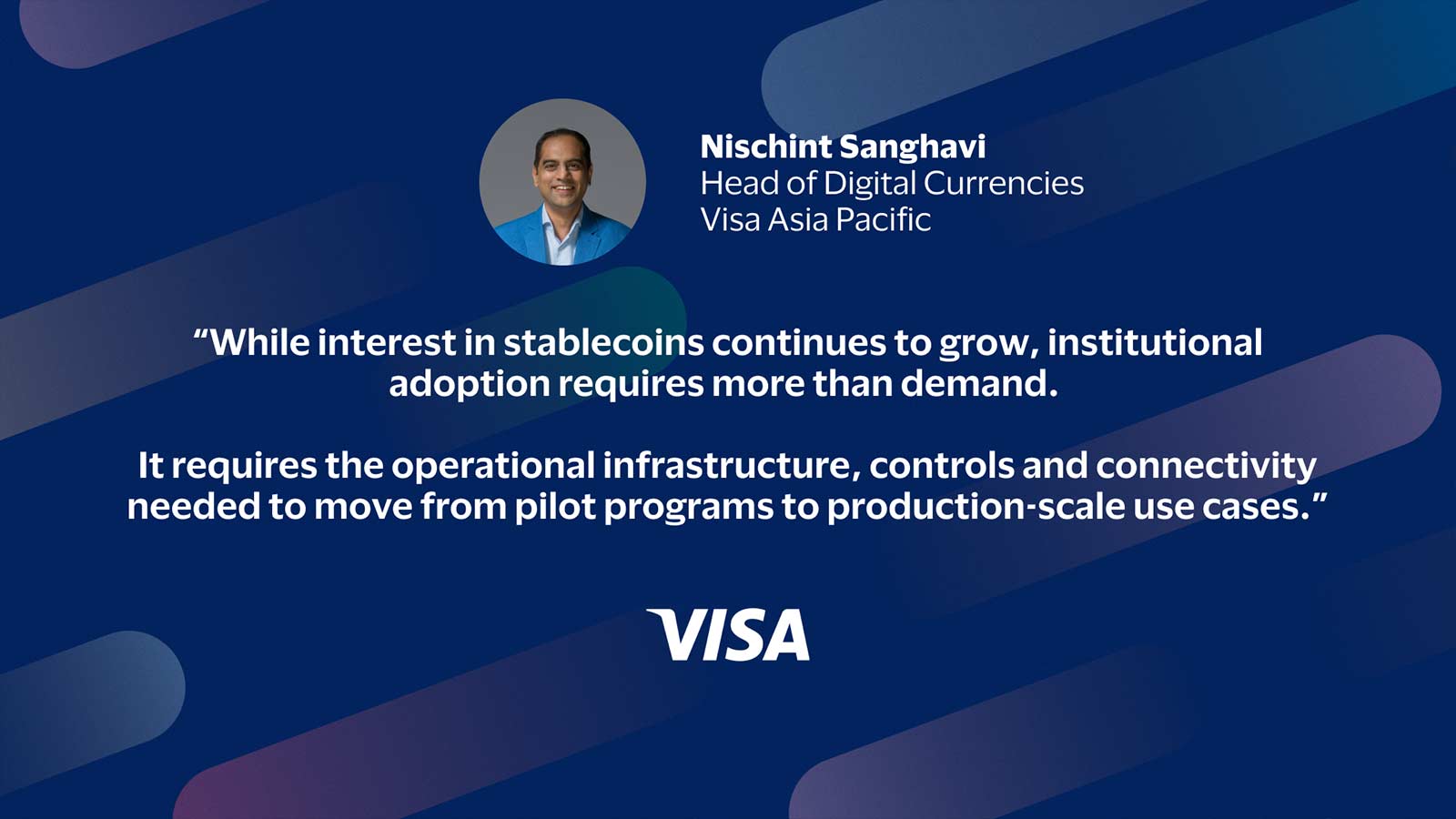
While interest in stablecoins continues to grow, institutional adoption requires more than demand. It requires the operational infrastructure, controls and connectivity needed to move from pilot programs to production-scale use cases.
That's why we are particularly proud of the recent launch of the Visa Stablecoin Platform (VSP).
VSP is Visa's unified platform for stablecoin operations, providing wallet infrastructure, Open USD access (with additional coins being available soon), fiat on/off ramps, and enterprise-grade controls to help clients adopt and scale stablecoin solutions.
What's important here isn't just the technology itself. It's what the platform represents.
The next phase for stablecoins is translating their potential into practical, scalable operational use. Institutions often face challenges integrating blockchain-based assets while maintaining compliance, control, and security. VSP addresses this by providing a unified platform that abstracts technical complexity while preserving institutional safeguards. Through APIs and a front-end portal, the platform now allows our clients to mint, burn, hold, and transfer stablecoins while operating within familiar financial workflows.
For Asia Pacific, this is particularly relevant. Many of the region's payment ecosystems are already among the world's most innovative, while businesses continue to navigate complex cross-border flows, treasury challenges and growing expectations for faster movement of funds.
An ecosystem that's growing up
The same principle applies beyond infrastructure. Achieving institutional scale will require more than technology. It will require industry coordination.
That's why we're encouraged by initiatives such as Open USD (OUSD). Visa recently joined more than 100 organisations supporting the initiative, reflecting a growing recognition that the future of digital money will depend on interoperability, broad participation and shared standards.
For Visa, participation in initiatives like these reflects a broader belief that the future of payments will not be built in silos.
As digital forms of value become more common, institutions will need trusted ways to connect networks, platforms, financial institutions and payment providers together.
Ultimately, the goal is to make moving money easier, safer and more efficient for businesses and consumers alike.
Why Asia Pacific is well positioned
Asia Pacific is uniquely positioned to help shape this next chapter.
The region combines some of the world's most dynamic payment ecosystems, rapidly evolving digital asset markets and significant cross-border payment flows. It is also home to many of the challenges stablecoins are particularly well suited to address, including liquidity management, settlement efficiency and international money movement.
That combination of demand, innovation and market diversity makes Asia Pacific one of the most important proving grounds for the future of stablecoin-powered payments.
Visa’s focus? Making sure this evolution scales safely, stays compliant, and works everywhere. That’s been our role through every major shift in payments, and it’s no different now. Visa started with crypto-native players - exchanges, wallets, early adopters. Now, we’re helping banks and financial institutions build their own stablecoin strategies.
Looking ahead, I hope the next phase of growth will be driven more by execution. As the ecosystem comes together at events such as Token2049 in the coming few weeks, the opportunity is not just to discuss what's possible, but to align around the infrastructure, interoperability and partnerships needed to make stablecoins work at scale. I'm excited to see where the ecosystem goes from here.